
The new ITIL product and service lifecycle model: a connected, ecosystem approach
Barclay Rae - ITSM consultant and David Cannon - Senior Director: ITIL
Why, historically, have digital products and services been treated as separate areas for creation and ongoing management?
The traditional plan-build-run model – in which plan was about the strategy and mapping of IT systems, build focused on creating the system (essentially, software) and run was responsible for ongoing maintenance – was both linear and inherently siloed.
Having two diverse lifecycles but with very separate people, skills and activities led, in practice, to a lack of cohesion and synergy across functions. This has resulted in predictable friction and problems such as lack of control, lack of governance, compromised security, heightened risk and inefficiency.
In the face of this, one of ITIL 4’s key approaches has been to recognize the role of agile and DevOps and to strive to bring the product and service lifecycles together. Today, the plan, build and run activities happen simultaneously - and each needs involvement of all teams.
With the rate of change in technology – moving from development to production more quickly and an increased frequency of releases via continuous integration and deployment – both development and service teams need to respond in a more aligned way to changes and refinements happening to products in their live phase.
Today, we have the opportunity to build digital products and services in a more joined-up fashion by establishing more connected ways of working across different teams.
Therefore, the new ITIL product and service lifecycle model offers a more integrated way to manage and govern the two lifecycles.
A shared view of end-to-end product and service management
Organizations expect their IT and service management experts to provide systems and applications that work, enable greater productivity and deliver customer value. The only way to ensure this happens is through effective collaboration between those responsible for creating digital products and their counterparts responsible for managing digital services: Digital products and services provide two perspectives of one technology-based solution to meet customers’ needs and – crucially – they share the same lifecycle and should be managed with an integrated approach. The thinking should be about end-to-end product and service management, in which each phase is shared – starting with discovery and incorporating some or all other phases including design, acquisition, building and testing, transition, operation, delivery and support.
The new ITIL product and service lifecycle model: an ecosystem approach
The new ITIL product and service lifecycle model aims to bring different elements together more intuitively.
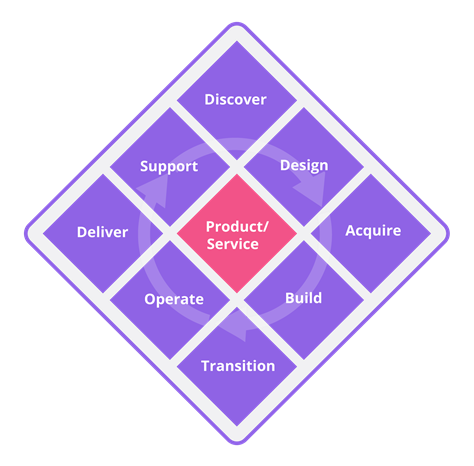
The model represents the shared lifecycle of digital products and services across eight key stages. This integrates what were previously perceived as activities owned by different “tribes” across the product and service spectrum, namely discovery, design, acquisition and allocation, building and testing, transition, operation, delivery and support.
This is a holistic approach which is neither prescriptive nor rigid; any of the activities could move backwards or forwards to any other activity. For example, transitions can happen between each activity in the lifecycle and, equally, every activity also has the potential for discovery.
In this way, the model adopts an ecosystem approach rather than a linear or siloed way of working. This means that versions of the same products and services can exist in multiple stages simultaneously. By making it clearer and simpler to see how these activities interact in a digital product and service lifecycle, this helps organizations operate in a more integrated way.
For the first time, this concept offers a more integrated approach to the lifecycles and the ability to select and manage the components that support an organization's strategy.
What will organizations gain from adopting this integrated model?
Practitioners and organizations adopting the product and service lifecycle model can expect to achieve greater organizational integration, not just technical integration.
Ultimately, what technology users in organizations expect is:
• Less rework because of poorly-communicated requirements.
• Value realized more quickly because teams collaborate to do things once, not pass them back and forth.
• Greater efficiency because both functional and “non-functional” requirements are built together - meaning no need for separate backlogs.
• Deployments and releases are more reliable because inefficiencies and dependencies are identified and managed earlier in the cycle.
• Faster resolutions and improvements because the product and service teams carry joint responsibility for the outcome, therefore more likely to have a shared understanding of priority.
For every IT practitioner and department struggling with workload and capability – and for managers and executives orchestrating how everything works together – the product and service lifecycle model provides in-built efficiency, the space for collaborative working, continual improvement and joined-up operations.
And, at the governance level, the model supports the mapping, activity and technology investment in a single governance framework. Technology is co-managed across different teams – with clearer communication, understanding where work happens and contributions to the value streams – which reduces risk and aligns with the overarching strategy.
Digital technology innovation happens properly when people collaborate and break down stubborn silos. Having access to a more integrated model of activities and working practices supports that; aligning different frameworks and facilitating the way teams work together to achieve organizational objectives.
Explore how the new ITIL builds on this integrated product and service lifecycle, combining practical guidance, modern ways of working, and AI-enabled thinking.